Whatever Is True – Exodus 20:1-17 and John 18:28-38
What is truth? That is the question that Pilate asked Jesus about 2,000 years ago, and it is a question that I think a lot of people are asking today. The answer, however, feels like it is only getting less clear over time. It feels a bit like this story sometimes:
Two men had an argument. To settle the matter, they went to a Sufi judge for arbitration. The plaintiff made his case. He was very eloquent and persuasive in his reasoning. When he finished, the judge nodded in approval and said, ‘That’s right, that’s right.’
On hearing this, the defendant jumped up and said, ‘Wait a second, judge, you haven’t even heard my side of the case yet.’ So the judge told the defendant to state his case. And he, too, was very persuasive and eloquent. When he finished, the judge said, ‘That’s right, that’s right.’
When the clerk of court heard this, he jumped up and said, ‘Judge, they both can’t be right.’ The judge looked at the clerk of court and said, ‘That’s right, that’s right.’”
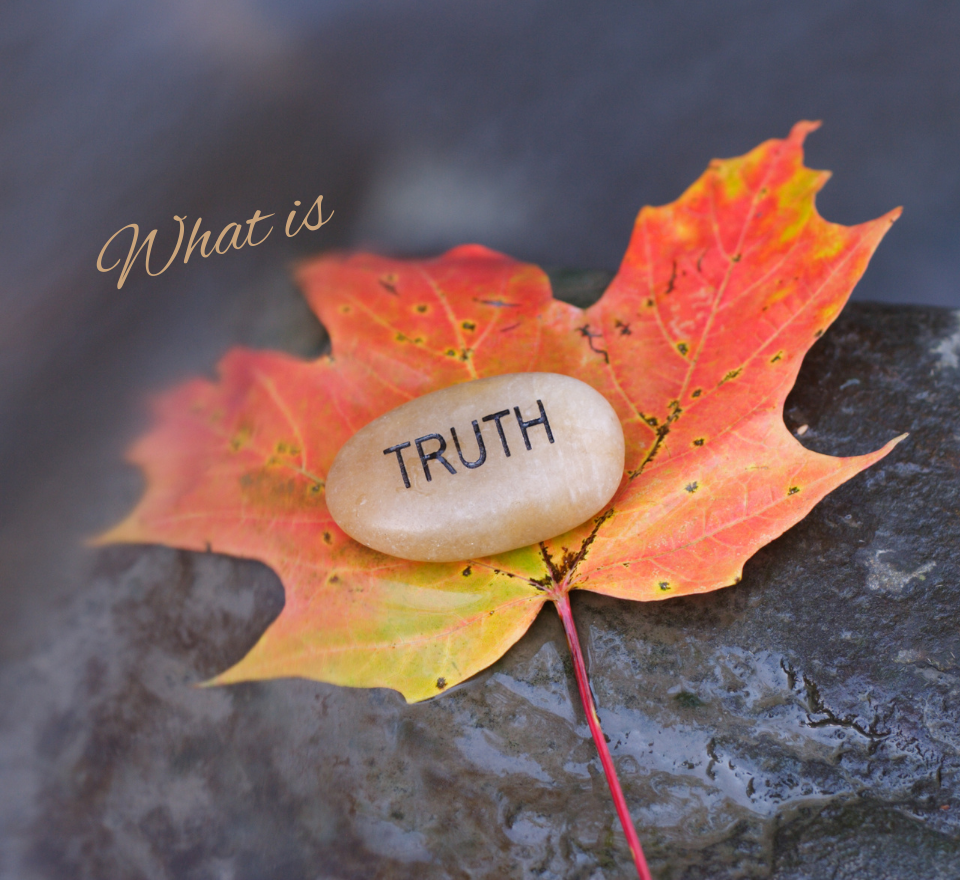
What is truth?
This morning we are beginning a new sermon series from Philippians 4:8, which says, “Finally, beloved, whatever is true, whatever is honorable, whatever is just, whatever is pure, whatever is pleasing, whatever is commendable, if there is any excellence and if there is anything worthy of praise, think about these things.” This week, we are looking at that first phrase “whatever is true.” Paul says that we are to think about whatever is true. How do we think about whatever is true if we don’t know what truth is? It seems an important thing for us to know if we want to think about it. So, what do we do? How do we determine what is true in order to focus on it? What makes something true and something else not true? And who gets to decide that?
One of my favorite Chicago Cubs broadcasters of all time, Harry Carey, once said, “There are three kinds of truth: your truth, my truth, and THE truth.” We are very good at distinguishing between my truth and your truth, but it is much more difficult to figure out what THE truth is. Jesus had some pretty solid ideas about what is true though. If we go back a few chapters from the passage we read in the gospel of John, we find a familiar passage that gets read a lot at funerals. It is the beginning of what scholars call Jesus’ Farewell Discourse. In the gospel of John, chapters 14 through 17 take place in the upper room after Jesus has washed the feet of his disciples, and they shared in the Passover meal. Then Jesus begins to talk, saying to them, “Do not let your hearts be troubled. Believe in God, believe also in me. In my Father’s house there are many dwelling places.” Do you recognize it? Do you remember the interaction with Thomas that follows?
Jesus talks about going to prepare a place for them, and he tells them they know the way to the place he’s going. And Thomas says, “How can we know the way if we don’t even know where you are going?” Jesus’ response to that is what I think is important for our discussion this morning. Jesus says to Thomas, “I am the way.” But not just that. He adds to it, “and the truth, and the life.” So, if we apply that back to our original question. What is truth? Jesus is truth. And that means that in order to determine what is true in the world, we must look at things through a Jesus-colored lens. We must use a Jesus litmus test. We must hold it up in the light of Jesus. Jesus actually says something similar in his response to Pilate’s questioning. Pilate wants to know if Jesus truly is the King of the Jews, but Jesus doesn’t care about that. Jesus only cares about his true purpose. Jesus says, “For this I was born, and for this I came into the world, to testify to the truth. Everyone who belongs to the truth listens to my voice.”
Rev. Jill Duffield, in her book Appreciate These Things, talks about a notebook she keeps with short statements or words of wisdom that give her insight into her quest to differentiate truth from fiction. She shares a small snippet of those insights, and I want to share those with you along with my own interpretation of how each insight might help in determining truth. The first one is: “It’s not about me.” It’s easier to see the truth of a situation if we are not directly involved. Isn’t that why we have judges who listen to arguments from both sides of a case and try to determine the truth? We want someone unbiased making that decision. The next is: “Faithful means over desired ends.” In other words, it is more important that we do things the right way than it is that we achieve the goal. She writes, “If I achieve the goal through hurtful or deceitful means, the end, no matter how good, will not be right.” Number 3: “Integrity, not control, is the goal.” If I were to reword this, I might say, “Truth cannot be controlled. It must be lived.”
Her fourth and fifth statements kind of go together. “Curiosity, not condemnation” and “Celebration, not cynicism.” Curiosity seeks to understand while condemnation seeks to tear down. Celebration seeks to lift up while cynicism seeks to sow doubt. With both of these, one seeks to find the good and lift it up, while the other seeks to find the bad and crush it. Truth should always be about seeking the good. The final three talk about generosity, presence, and humility. I think that whatever is true will generally exhibit those three characteristics. I think that this list, while not a perfect test, can serve as a guide for us to evaluate our actions, our thoughts, and our environment in terms of what is true and what is not. Ultimately however, the test of what is true is the testimony of Jesus.
In Philippians 4:8, the Greek word translated as “true” is the word alethe. Alethe comes from the combination of two words: a meaning “not” and lanthano meaning “concealed” or “hidden.” So, alethe means “not hidden.” The concept of alethe was of something that cannot be hidden, an undeniable reality. This discovery led me down a bit of a wormhole. Alethe without the a is lethe, which is the name of one of the rivers of Hades in Greek mythology. The River Lethe is the river whose waters make you forget everything. I always imagined that those memories were just washed away forever. But there was another river mentioned in some myths called the River Mnemos. Mnemos is Greek for remembering, from which we get amnesia, which is the opposite of remembering. In the myths, the River Mnemos restores the memories lost by those who fell into the River Lethe. That tells me that the River Lethe did not wash the memories away, but simply concealed them.
I share these ramblings with you because they feel important for our world today. It feels like we are at a point in our history where there are very few realities we are incapable of denying. In other words, we’ve gotten pretty good at hiding the truth, even from ourselves. In many ways, it’s as if we’ve taken a dip in the River Lethe. We’ve forgotten what is true. We’ve forgotten what our past has taught us, what we once believe so strongly. We’ve even forgotten the truth that Jesus came to witness to. And I don’t know about you, but I sometimes worry that truth is gone forever, it has been washed away by the River Lethe. But maybe it’s just concealed.
While we can’t really fix the collective memory of our nation or our world, what we can do is explore our own values, compare those values to the testimony of Jesus, and consider how truly we are living into those values. So I want to share with you a challenge from Rev. Duffield’s book that you can work on this week. She suggests this: “Make a list of your core truths, those principles and values that are unshakeable. When you look at the list, consider whether or not your life reflects them.” (Duffield, p. 22) What are the values in your life that are the most important to you? What are the principles that you feel you must strive for in your life? Write them down. Then hold them up to the litmus test of Jesus Christ. And if they are truths confirmed by the testimony of Jesus, then ask yourself: “How am I truly living these truths?” In this way, we can think upon whatever is true. This won’t change the world and the lies being told, but it might change how we interact with the world. And it may give us hope that the truth will not remain concealed forever.
What is truth? Truth is that which was revealed to us in Jesus Christ, the son of the living God. So let us think upon, let us appreciate, all that is true. For everyone who belongs to the truth listens to Jesus’ voice. May our ears and minds be open. Amen.