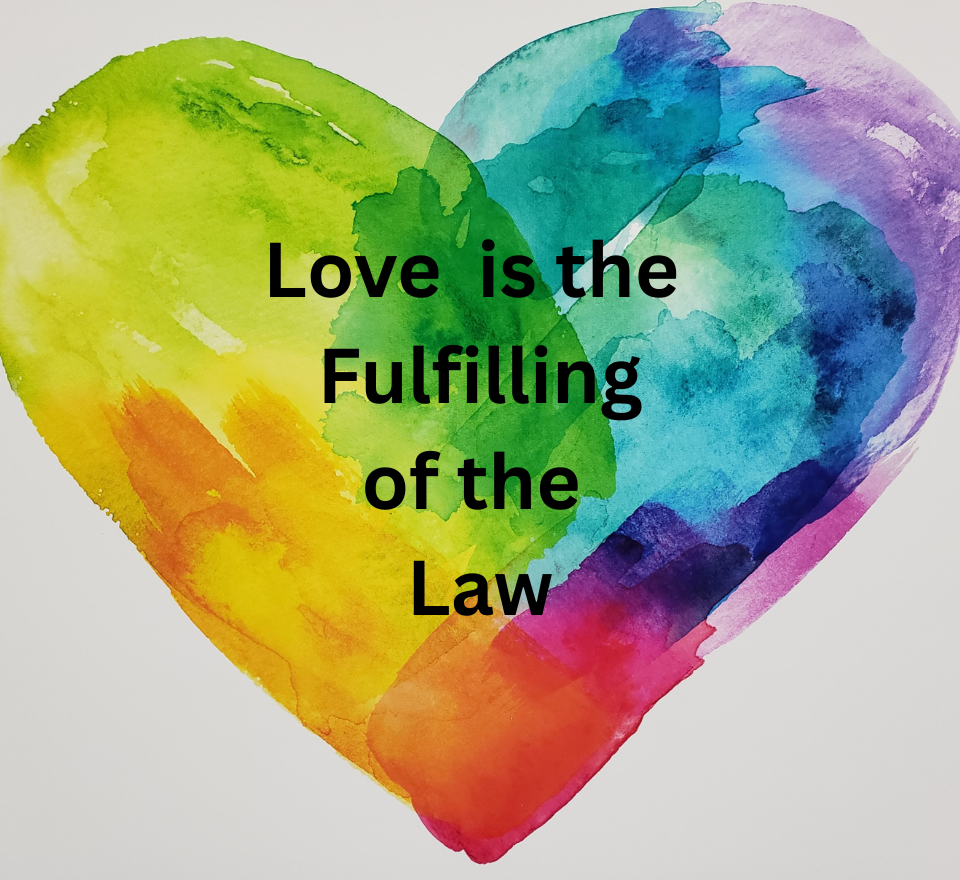
Love Fulfills the Law – Romans 13:8-14; Matthew 18:15-20
Eleanor Shellstrop is a self-centered, party hard thirtysomething on the television show The Good Place. All of her relationships are shallow, including her relationships with her seeming best friends and roommates. She does what she wants when she wants, largely because she truly believes the only thing that matters in life is doing what makes yourself feel good in the moment. I won’t say she prioritizes what makes her happy because she doesn’t really seem happy. Instead, she seems overly confident, impulsive, and pushes people away the moment they start to get close. She rationalizes doing a dishonest job as a telemarketer who sells pills that don’t work to desperate people by saying it’s not her fault if other people don’t think things through.
Eleanor ends up dying in a humiliating way in the parking lot of the grocery store, and in the afterlife she meets Chidi, a professor of ethics who can’t make a decision to save his life. Chidi struggles to make decisions because he knows that even the most well-intentioned decisions can have horribly unintended consequences. Because Chidi overthinks every decision he makes out of fear of harming himself or someone else, he seems like self-centered Eleanor’s exact opposite. In reality, however, they are both more alike than they realize. Eleanor makes choices impulsively because she is only thinking about herself; Chidi doesn’t decide at all because of fear, and his indecision makes everyone else put their lives on hold for him.
Later on in the series, Chidi gives an ethical lecture titled “What We Owe to Each Other.” Is it true, like Eleanor believed, that nothing matters except doing what you want to do for yourself? Or is it true, like Chidi once believed, that everything we do matters so much that we must agonize over every decision so that we don’t choose poorly? Or, is the right answer somewhere in between? Do we have any obligation to each other, or is our only obligation to ourself–or to God? I knew someone once who refused to let anyone ever pay for her meal at a restaurant. It didn’t matter how much she was struggling or how much the other person wanted to treat her, she just wouldn’t let them. When I asked her why, she told me that no gift ever comes without strings attached. The only way to go through life without being obligated to others was to make sure you never owed them anything. What do we owe each other, really?
Even though the apostle Paul wrote the book of Romans over 2,000 years before The Good Place was even a thought in someone’s mind, he answered Chidi’s question this way: “Owe no one anything, except to love one another, for the one who loves another has fulfilled the law” (Romans 13:8). Owe no one anything…except for love. That seems like a really big exception to me. Love isn’t just a feeling. It’s not something that’s easy to demonstrate. Love demands enough of us that Paul wrote an entire chapter about it in 1 Corinthians when he wrote this:
“Love is patient; love is kind; love is not envious or boastful or arrogant or rude. It does not insist on its own way; it is not irritable; it keeps no record of wrongs; it does not rejoice in wrongdoing but rejoices in the truth. It bears all things, believes all things, hopes all things, endures all things. Love never ends.”
Owe no one anything except for love, and love requires a lot of us. Paul goes on to list some of the commandments: “The commandments, ‘You shall not commit adultery; you shall not murder; you shall not steal; you shall not covet,’ and any other commandment, are summed up in this word, ‘You shall love your neighbor as yourself.’ Love does no wrong to a neighbor; therefore, love is the fulfilling of the law.” I once heard someone say that the first four commandments teach us how to love God, and the next six commandments teach us how to love our neighbors. The apostle Paul seems to agree with that. The commandments weren’t given to us to make our lives more difficult or to require us to live sad and isolated lives. On the contrary, the commandments were given to help us know what it means to love one another, and as we love one another, we are loving the God who made all of us.
Dolly Parton once said, “We’re all pieces of God and we all have that little God-light inside us… That’s how I accept everybody because I know that we’re all pieces of God.” And that’s what it’s all about. Our primarily calling is to love God, and one of the ways we do this most often is by loving the people God created–all of our neighbors, and even ourselves. We all have that “little God-light inside us,” and we fulfill God’s law by loving each person God places into our paths.
Romans 13 continues: “Besides this, you know what time it is, how it is already the moment for you to wake from sleep. For salvation is nearer to us now than when we became believers; the night is far gone; the day is near. Let us then throw off the works of darkness and put on the armor of light…” Have you ever been somewhere and lost track of time? Sometimes it is a wonderful thing. You get so immersed in the moment that time stops mattering. When Jeff and I got married, our pastor told us he was only going to preach for five minutes. During the ceremony, it felt like maybe he went a little longer than five minutes, but for the most part, we were just so happy, so caught up in the moment, that it didn’t seem like much time had passed at all. After the ceremony, someone told me the pastor preached for half an hour. I was shocked! We had prepared for that ceremony for over a year. In the moment, it passed in the blink of an eye, but to an observer…that sermon went on for.e.ver.
But a lot of times when I forget what time it is, it’s not a positive thing. I lose track of time and end up late to something. I get caught up in a project and I forget to eat until it’s late. I put off a form for the kids’ school so long that I forget about it…until they call or text reminding. For the Christians in the church at Rome, Paul says they know what time it is–the time to wake up; it’s much closer to the time of salvation than it was when they first believed. And yet, why does he have to say this to them?
Sometimes when my alarm clock goes off in the morning, I hit the snooze button. I don’t do that because I really don’t need that nine minutes for getting ready for the day. I do it because I convince myself I need to stay asleep longer more than I need to get up sooner. And then, after I have had that extra nine minutes of sleep and I get out of bed, what do I do? Panic a little bit because I waited too longer to get moving. Paul writes to them and tells them they already know what they need to be doing. They already know that they are to be loving their neighbors and showing God’s love to others. They already know that the time of Christ is coming soon. And yet they also seem to have forgotten that it’s time to wake up and do the work. The time is now.
If love is the fulfilling of the law, and if the time to wake up and get to work is now, what does this all mean for us today? I want to suggest two things we can do. I’m sure there are more, and I’d love to hear your thoughts on what I’ve missed. The first thing we can do today is stop putting conditions on our love. We are called to love our neighbors as we love ourselves, but that doesn’t mean we should only show love to people who also show love to us. In fact, Jesus says this in Luke 6: “If you love those who love you, what credit is that to you? For even sinners love those who love them…Instead, love your enemies, do good, and lend, expecting nothing in return.” When Jesus calls us to love our neighbors, he calls us to do so regardless of how our neighbors treat us in return. Now, this doesn’t mean we need to allow people to hurt us over and over, and it doesn’t mean we should become doormats. But, our call to love others does not depend on whether or not they love us back. As C.S. Lewis once wrote,”Love is never wasted, for its value does not rest on reciprocity.”
The first thing we can do is love without conditions. The second thing we can do is stay aware of the time. I’m not talking about a physical clock. I’m thinking more about the time we are each given. It can be so tempting to think, “I’ll get to that later,” or “Maybe I’ll change my life when” this or that happens. But none of us ever really knows how much time we have personally, or how much longer we have until Christ returns. Each moment is precious.
When I was in high school, a friend of mine told me on his 18th birthday that he had spent 18 years following all the rules, and now he was going to spend 18 years breaking them all. He believed that when he turned 36, he could change back to following all the rules again. When I ran into him later, he confessed things hadn’t worked out so well for him. He had picked up some bad habits he couldn’t manage to kick, and he experienced a lot of regret about things he had chosen to do. Even as he changed his life later on, he couldn’t erase those painful previous decisions.
Friends, let’s love our neighbors without conditions. Let’s love ourselves because we, too, possess those little “God-lights” inside of us. And let’s make the most of the time we have been given–not in the busybody sense of filling up our minutes as full as possible, but in the sense that we are called to make our moments count for something. Following Christ is not about keeping all the right rules perfectly, but about living in the fulfillment of the law. Jesus showed us perfect love when he gave his own life for us and for the life of the world. His love fulfilled the law, and every time we love others with that same unconditional love, we join him in the fulfillment of the law.
Friends, let us wake from our sleep and see how much closer the time has come. Salvation is nearer to us than when we first believed. Let us respond with gratitude by loving lavishly, and by making our moments count. Amen.