O Come, Desire of Nations: The LOVE that unites us! – Haggai 2:5b-9 and John 1:9-18
We have reached the fourth and final Sunday of Advent. And the candle we lit this morning is the candle of love. Love is a popular topic. But I sometimes think that we have a love/hate relationship with the topic of love. More popular songs are written about love than probably any other theme…songs about love gained, love lost, and love desired. Movies, no matter the overall theme, almost always include some sort of love story. Love is complex and complicated. The concept of love is so complex in fact that the Greek language has eight different words for love. Yet in English, we can love anything from pizza to our spouse to God and many more things in between. Which only further complicates the word. And so when we come to this week in Advent, we may wonder what form of love are we even talking about. And this year, we may be struggling with the topic of love since we are more isolated than ever and many of us will not get to see our loved ones for Christmas this year. Where is love in the midst of a global pandemic?
The verse we are singing this week from “O Come, O Come Emmanuel” says, “O come, Desire of nations, bind all peoples in one heart and mind; bid envy, strife, and discord cease; fill the whole world with heaven’s peace.” The term “desire of nations” comes from our passage from Haggai and many believe that it refers to the Messiah. The writer of “O Come, O Come, Emmanuel” clearly viewed the term in this way. And I love what he calls on the Desire of Nations to do. “Bind all peoples in one heart and mind.” It expresses a desire for unity and camaraderie. But deeper than that, I think it expresses a desire for the kind of connection to one another that Jesus has with the Father.
In the gospel text for today, John talks rather poetically about the birth of Jesus and the importance of who Jesus is. And John ends with this line, “No one has ever seen God. It is God the only Son, who is close to the Father’s heart, who has made him known.” We know who God is because of Jesus, because Jesus is close to the Father’s heart. The original Greek says that Jesus is in the Father’s bosom. Being in the bosom of the Father is an act of intimacy…an act of love and closeness. We know who God is because Jesus was close to God in a way none of us have ever been. And because of that intimacy, Jesus understood God like no other. And the result of that knowledge of God was love…a love that dined with sinners, a love that healed the sick, a love that forgave sins, a love that died on the cross to save the world.
I don’t know about you, but the Christmas season is a time that really highlights love for me. It’s a time of year when people tend to be more generous, when families try to put aside their grudges and disagreements in order to embrace love again, a time when something truly magical happens that connects us in very special ways. This year feels hard because it is those exact things that are more difficult. How are we to be more generous when we can’t physically connect with people as we serve them? How can we set aside the things that divide us when we can’t gather? Where is the magic supposed to happen when we are celebrating alone? Love seems far off…something we cannot realistically hope for this year.
So, what are we to do with Advent 4 this year? How do we celebrate love, when we can’t be with or embrace those we love? I’ll be completely honest that I’m not sure I have the answer to that. But I will tell you what thoughts have crossed my mind as I looked at the Scripture from John this week. Jesus was separated from his family, too. The Bible says that Jesus, “though he was God,…did not think of equality with God as something to cling to. Instead, he gave up his divine privileges; he took the humble position of a slave and was born as a human being.” Jesus left his throne in heaven in order to become human. And our text from John says, “He came to what was his own, and his own people did not accept him.” It’s certainly not the same as our present situation, but I think Jesus understands the pains of separation and isolation. Jesus can be a source of comfort for us in these times because Jesus can relate to our struggles.
And not only does Jesus relate to us, Jesus gives us the “power to become children of God.” I believe that has two important consequences for us. First, it means we are never really alone. Even when we can’t gather with our loved ones for the holidays, we are still not completely alone. God is with us. Matthew writes, “‘Look, the virgin shall conceive and bear a son, and they shall name him Emmanuel,’ which means, ‘God is with us.’” Jesus was born specifically to let us know that God is with us. We are never truly alone. But also, we are part of a family. As children of God, we are part of God’s family, which means that you and I are brothers and sisters. And the family of God extends all across the world. And even though we can’t gather right now, it is still comforting to know we have each other and to know that people are praying for us and care for us. I have felt a great deal of love from this church throughout this pandemic, whether it be from a kind word, an encouraging note, a well-timed call or text, or a thoughtful gift. I hope all of you have had a similar experience of love and caring.
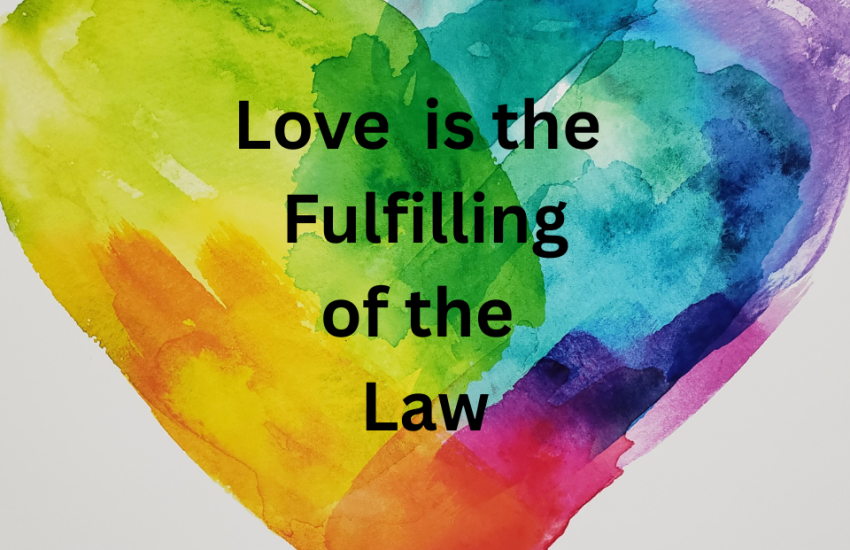
That brings us back to verse 7 of “O Come, O Come, Emmanuel.” “O Come, Desire of nations, bind all peoples in one heart and mind.” We live in a society and a world that is deeply divided. Our own nation seems split in two right now. We see families broken apart by political differences and churches splitting over doctrine. Tools designed to keep us connected have become the means of dividing us. So, the prayer from this verse of the hymn seems deeply appropriate right now. And I believe that it is all about love. They say that “love covers a multitude of sins.” And I honestly believe that love is the only thing that can save us from what is dividing us. Love is the only thing that can bind us in one heart and mind.
One of the greatest Bible passages about love comes from 1 Corinthians 13. It is a passage often read at weddings. And as I was writing this sermon, I came across a Christmas version of 1 Corinthians 13 that someone wrote. And I thought perhaps it was something important for us to hear this morning. So, I want to close this sermon by reading it.
If I decorate my house perfectly with plaid bows, strands of twinkling lights, and shiny balls; but do not have love, I’m just another decorator.
If I slave away in the kitchen, baking dozens of Christmas cookies, preparing gourmet meals, and arranging a beautifully adorned table at mealtime; but do not have love, I’m just another cook.
If I work at a soup kitchen, carol in the nursing home, and give all that I have to charity; but do not have love, it profits me nothing.
If I trim the spruce with shimmering angels, and crocheted snowflakes, attend a myriad of holiday parties, and sing in the choir’s cantata; but do not focus on Christ, I have missed the point.
Love stops the cooking to hug the child. Love sets aside the decorating to kiss the spouse. Love is kind, though harried and tired. Love does not envy another’s home that has coordinated Christmas china and table linens. Love does not yell at the kids to get out of the way, but is thankful they are there to be in the way.
Love does not give only to those who are able to give in return, but rejoices in giving to those who cannot. Love bears all things, believes all things, hopes all things, and endures all things. Love never fails.
Toys will break, pearl necklaces will be lost, golf clubs will rust; but giving the gift of love will endure.
May we all feel the love of God this Christmas and always! And may we then share that same love with one another, our brothers and sisters in Christ. And may that love bind all peoples in one heart and mind. Amen!