The Shepherd Who Gathers – Colossians 1:11-20; Jeremiah 23:1-6
When our family adopted our Jack Russell terrier Wishbone almost exactly ten years ago, I was a rookie to having a dog. As a middle schooler, I surprised my parents by bringing home a pet gerbil a friend had given to me. But, apart from keeping the gerbil for almost three years, and occasionally having pet fish in the house to feed, I had no idea what I was doing as a pet owner. True to other dogs in his breed, Wishbone is energetic, intelligent, and stubborn. He will chase anything that moves, and he loves to bark at big trucks as they drive by–especially the UPS truck.
Even though we had repeatedly told our kids we would not be adopting a dog at Christmas time, we brought Wishbone home on December 23, 2015. The Humane Society sent us home with a little stuffed soccer ball, a bandana for Wishbone’s neck, and a little ribbon leash as a temporary leash. We quickly replaced the leash with something more durable, and the first time we tried to take a walk, Wishbone wiggled out of his collar. We ended up buying a dog harness so that he would be secure when we walked.
One day, as we were walking through the park, Wishbone saw something he wanted to chase. He froze in his tracks, then he started to back up. Within seconds, he had pulled himself out of his harness and took off running down the sidewalk in the park. Instinctively, we started chasing him. He turned to look behind him, and when he saw us running, he started running even faster. After a moment, it became apparent that we were not going to be able to catch a young Jack Russell terrier who wanted to catch a bunny and who enjoyed being chased by his people. Even though it seemed backwards, we stopped running. And instead of chasing, we started calling his name. His ears perked up, and soon he was running back towards us. When he reached us, we got him back into his harness and showered him with pets and hugs and “good boys.” I don’t know if he had any idea how afraid we were as he was running away, but there’s no doubt in my mind that he knew exactly how happy we were when he had been safely gathered back into our arms.
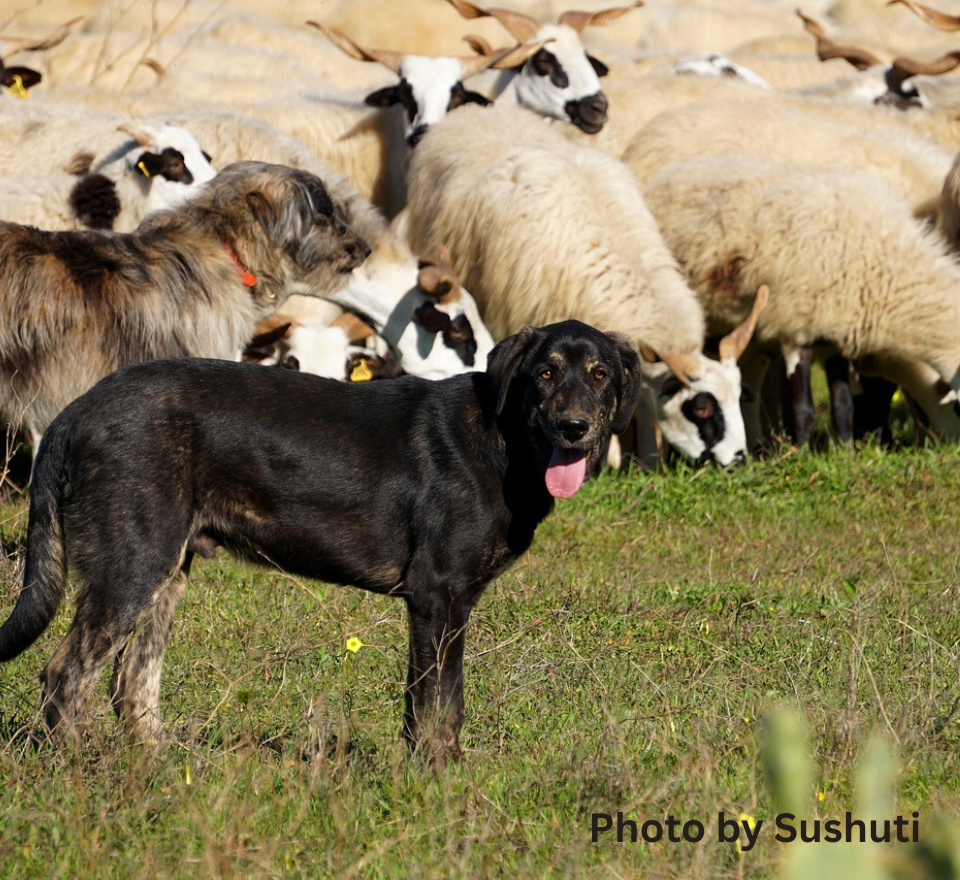
In our Scripture passage from Jeremiah, we encounter two kinds of shepherds: those who mislead and scatter the flock, and those who would protect the flock and go in search of them until not one is left behind.
As I’ve reflected on these two kinds of shepherds, I’ve found myself thinking about the many things we gather in our lives, and the many things that scatter. We gather solo socks from dryer loads of laundry until we find the missing sock for each pair. We pace the lawn after a storm and gather up the sticks so that we won’t wreck the lawnmower the next time we mow. We pinch fabric together in gathers as we sew. We gather collectables and ingredients for cooking. We even gather people – like at the holidays when people come from their various homes to share time together under one roof.
But, I will never be able to think of the word “scatter” without thinking about Corelle plates, especially after looking at the word translated as “scatter” in the Hebrew. The word for “scatter” in this passage is poots (puwts), and it means to “to dash into pieces.” To break into bits so that the bits are scattered far and wide. I have long heard it said that Corelle plates are shatter proof, and I think the older style Corelle plates probably were more so than the newer stuff. That said, one time, Jeff accidentally dropped a little Corelle plate. It was a plate that was about the size of a saucer. The plate had barely touched the tile floor in our kitchen, when it shattered in such a spectacular fashion that both Jeff and I froze in our tracks. The plate shattered into the tiniest of pieces, and the pieces traveled so far that we even found shards in the cabinet. For weeks, we found little particles of shattered plate all over our kitchen. As I imagine the shepherds who destroyed and scattered the people, I imagine the disaster of that broken plate. The people of Judah had suffered and been destroyed and scattered to a point that likely made any hope of restoration seem impossible.
You see, Judah had suffered under a series of evil kings after the death of good King Josiah around 609 BC. Josiah had led the people in a time of renewal as they turned back to God, and during his reign the people lived in peace and prosperity. After his death, however, the people were ruled by a string of wicked kings, each one straying more from God than the one before them. God had called the prophets to speak to these rulers, but they did not listen. As a result, the people struggled and suffered under the harsh rule of kings who were not seeking the wisdom of the Lord. Elna K. Solvang, Professor of Religion at Concordia College, summarized the situation this way: “Each king has failed in his duty to ‘execute justice in the morning and deliver from the hand of the oppressor anyone who has been robbed’ (Jeremiah 21:12a). In contrast to King Josiah (640-609 BCE) who ‘judged the cause of the poor and the needy’ (Jeremiah 22:16), the ‘eyes and heart’ of Josiah’s heirs are set on ‘dishonest gain, for shedding innocent blood, and for practicing oppression and violence’ (Jeremiah 22:17).” Eventually, this damaging leadership ended with the overthrow of Judah by the Babylonian army, and the people were carried off into exile.
Shepherding was such a common occupation during the time of Jeremiah that the word “shepherd” became a way of referring to kings as well. And it makes sense. Shepherds are supposed to lead and guide their flock. They protect the flock from attack, and they keep the flock safe at night. Shepherds allow the flock to graze and move and live, but everything the shepherd does has an impact on the flock under his care. The shepherds that did not take good care of their flock were the kings of Judah, and the prophet says even though these bad shepherds did not “attend” to their flock in the way they should, God would “attend” to the shepherds. In other words, judgment was coming.
But, God doesn’t spend time describing the punishment for these cruel shepherds. Instead, God’s attention turn to the people who are suffering. Through the prophet Jeremiah, God promises a day when they will be gathered in, rather than scattered. In verses 3-4 we find this beautiful promise, a promise that echoes the words of God to the first people in the Garden of Eden: “Then I myself will gather the remnant of my flock out of all the lands where I have driven them, and I will bring them back to their fold, and they shall be fruitful and multiply. I will raise up shepherds over them who will shepherd them, and they shall not fear any longer, or be dismayed, nor shall any be missing, says the Lord.” After enduring hardship and exile, after feeling forgotten, the people are promised that God would come to them, would draw them close, would gather them in, and would bless them. What a beautiful promise!
Today is Christ the King Sunday, or reign of Christ Sunday. In the church year, this is like New Year’s Eve because next week a brand new church year begins. Next week, we begin anew with the Advent journey as we prepare and wait for and celebrate the coming of the Christ child. But today? We celebrate the majesty, the authority, the reign of Christ, and the good news that because Christ is the ruler of everything, we have hope and a future. Today, we celebrate that no matter what we are going through, no matter what life has handed to us, no matter how broken or lonely or forgotten we feel, we are protected by a shepherd who doesn’t scatter or destroy us. We are protected by the Shepherd who loves us enough to go in search of us. We are led by the Shepherd who will not rest until everyone of us is found. We are loved by the Shepherd who draws us into his heart and blesses us.
Quite often on Sunday mornings, we focus our message on tangible actions we can take as we seek to follow in the footsteps of our Savior Jesus. But today, I want to focus instead on the condition of our hearts. We are bombarded daily with messages about what we are lacking. We are encouraged to be dissatisfied with our appearance, with our clothes, with our possessions, and even with our relationships with each other. These seeds of dissatisfaction are sown in our minds and hearts because dissatisfaction motivates us to spend our money. It motivates us to chase bigger and better things. It encourages us to keep our minds focused on the wrong things.
These constant messages of discontent and unhappiness destroy us inside. They diminish our sense of self-worth. They scatter us apart from each other and away from the tender embrace of God who longs to speak a blessing over us, rather than condemnation. As we prepare for Thanksgiving, whether we will spend the day with others or by ourselves, the most radical act of resistance we can make to the destructive shepherds of this world is to be grateful. The most powerful stance we can take is one of contentedness. The most beautiful posture we can embody is one of thankfulness.
Friends, there are forces at work in this world that are intent on scattering us. There are powers and voices that want us broken and hidden away. But these forces, these powers, these voices are nothing compared to the Shepherd who seeks us out, who loves us, and who gives us everything we need. They might seem powerful, but their power lasts only for a moment compared to the grandness of the eternal God who loves us.
Let us resist what destroys by standing firm with gratitude. Let us push away the fear and the self-doubt with thanksgiving. And let’s allow ourselves to be found by the God who will never stop searching for us until he brings us home. I’m reminded of my little dog Wishbone realizing I was calling for him when he was loose in the park. He didn’t even hesitate. He turned around, stopped chasing after what was taking him away from us, and he bounded with joy into our arms. What a delight it will be for each of us as we turn away from what is leading us away from God, only to discover that God has been searching for us, waiting for us, and hoping for us with arms wide open.
I want to close with a quote I came across by President Grover Cleveland. On Thanksgiving Day in 1886, Grover Cleveland said this about this importance of giving thanks:
“And while we contemplate the infinite power of God in earthquake, flood, and storm let the grateful hearts of those who have been shielded from harm through His mercy be turned in sympathy and kindness toward those who have suffered through His visitations. Let us also in the midst of our thanksgiving remember the poor and needy with cheerful gifts and alms so that our service may by deeds of charity be made acceptable in the sight of the Lord.”

You are SO good, April. Your sermon was uplifting and I am grateful that on this Advent Eve I have been blessed…