Whatever Is Pleasing – 1 Samuel 16:1-13 and Hebrews 13:16-21
Every time I go through the drive-thru at Culver’s here in town and place my order, when the worker has taken my order and told me the price, I always say, “Thank you.” This is a habit I follow at every drive-thru I go through, but something different happens at Culver’s. After I say, “Thank you,” they almost always respond, “It’s my pleasure.” That’s a phrase which often just means, “You’re welcome.” It is basically just a polite response to someone thanking us. For some reason though, whenever I hear it at Culver’s, it stands out to me. What does it really mean to say, “It’s my pleasure,” to someone?
The phrase comes from the Latin word placere, which means “to please.” If you trace it back even further, it originates from a Proto-Indo-European root pleh, which means “to fill” or “to be full.” This might suggest that pleasing things have some fullness of value. Interestingly, placere is also the word from which we get the word “place.” “Place” might then be described as a “physical representation of something that holds value.” (goong.com) We might derive from this that the phrase “It’s my pleasure” could mean “this activity is full of value for me.” I’m guessing that’s not what the workers at Culver’s are thinking when they say it though.
I also don’t think that “fullness of value” is what we usually think of when we talk about pleasure either. We usually think about pleasure as being something that makes us happy. Its only value most times is in how it makes us feel. Sometimes, the things we think of as pleasurable do less to arouse a positive emotion within us and more to simply numb us from all the negative emotions that threaten to drag us down. Rev. Jill Duffield talks about this desire, in the midst of the pains of the world, to escape into something that brings pleasure, or at least reduces the pain. She tells a story about reading of all the horrible tragedies in the world from the news headlines and then hearing sirens outside her window that suggested yet another tragedy in the world. As the siren passed by, she heard the sound of recorders being played, a weekly occurrence at her church as a group of adults practice together. At first, the sound made her mad as it seemed too chipper for what felt like the end of the world. She wanted to go tell them to stop, until she had a realization. She writes, “I stopped and, instead, recognized what I ached for in that moment. I can’t say it was a recorder concert, but something akin to it, something seemingly foolish, useless, and affront to the seriousness and sadness of the world. I ached for beauty…I wanted to rebel against the suffering – so big and pervasive and unrelenting – with whatever felt pleasing this very moment.” Rev. Duffield wanted something pleasurable to numb the pain of what she was seeing in the world.
This idea of using pleasure as an escape has led many to associate pleasure with things like sex and drugs and other things that provide a temporary distraction. When we do that, pleasure can become something bad that is to be avoided. 1st century Stoic philosopher Epictetus once wrote, “It is the nature of the wise to resist pleasures, but the foolish to be a slave to them.” In Christianity, we often talk about “worldly pleasures,” which we deny ourselves in favor of serving God. So, are the things that are pleasing to us bad? If so, why would Paul tell us to appreciate these things?
The word that Paul uses for pleasing in Philippians 4 is a word not used anywhere else in the Bible. It is the combination of two words: pros meaning “toward” and phileo meaning “love.” Phileo is an affectionate and caring love. Paul calls us to appreciate whatever is moving toward love, whatever is moving toward care and compassion. That sounds a lot different to me than “whatever is pleasing.” Perhaps Paul doesn’t mean that we are to focus on what is pleasing to us, but what is pleasing to God. Sometimes, hopefully a lot of the time, those two things are the same. And that is really the goal of the Christian life, that what is pleasing to us falls in line with what is pleasing to God.
The author of Hebrews wrote, “Do not neglect to do good and to share what you have, for such sacrifices are pleasing to God.” It is pleasing to God when we do good to others and when we share what we have. The Greek word used by the author of Hebrews here, and again in verse 21, for pleasing is a different word than what Philippians 4 uses. The word here means “acceptable” or “well-fitting.” The sacrifices of doing good and sharing what we have are well-fitting to God. I take that to mean that those are the things we were created to do. We were made to do good and to share what we have. But somewhere along the way, we moved away from that. Philippians is calling us to focus on moving back toward that.
Unfortunately, doing good and sharing what we have are not as simple as they sound. We live in a world that doesn’t want to share, a world where people openly hate those who disagree with them and want to destroy them rather than following the path of Jesus and choosing to love our enemies. We live in a world where the rich keep getting richer by taking from the poor rather than choosing to share that wealth with others. We live in a world where many people care far more about themselves than about anyone else. Yet God calls us, God’ people, to be different than the world, not by denying ourselves pleasure, but by shifting our pleasures to be in line with what is pleasing to God. One way we can do that is to open ourselves up to others, not just to those closest to us, but to those we don’t understand, those we don’t like, those we deeply disagree with. That doesn’t mean that we waffle on our convictions, but that we don’t rule out the possibility that we could be wrong.
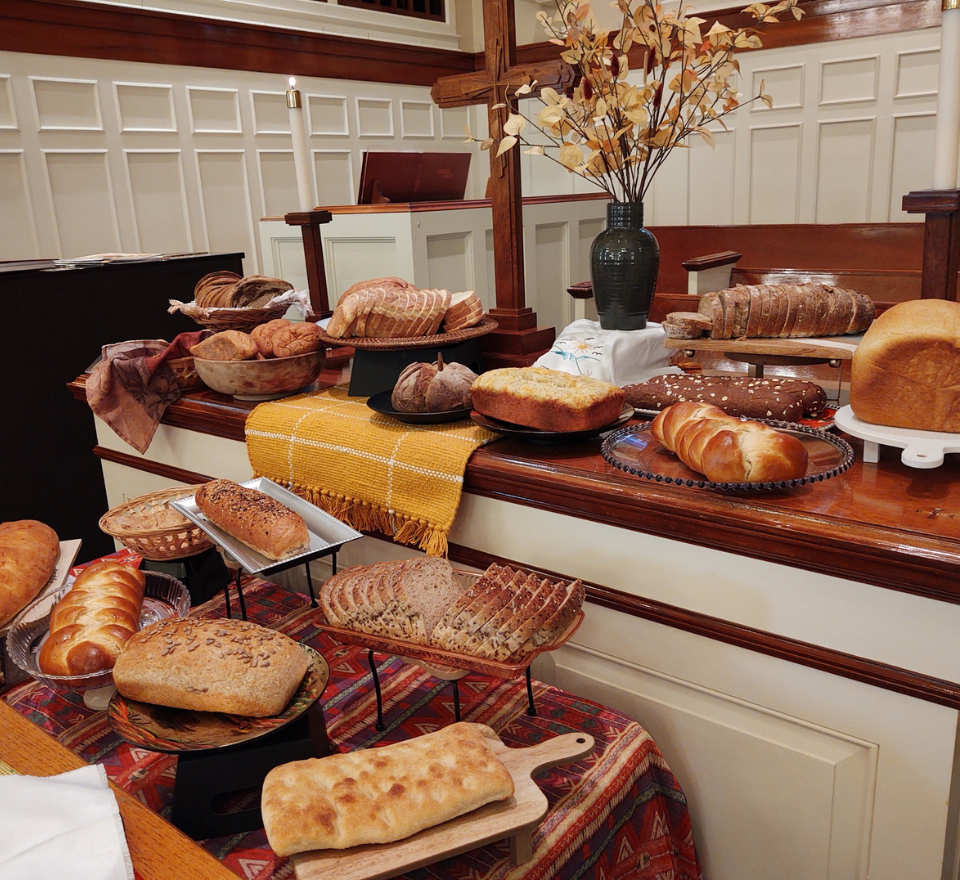
This morning, we are being offered the opportunity to come to the table of our Lord Jesus alongside millions of other believers all across the world. And in doing so, we are united to one another, to God, and to the Church universal. We are united across denominations, creeds, countries, and affiliations. This serves as a reminder that the kingdom of God is not restricted just to this place and this body. The kingdom of God is not restricted to just one denomination or country or creed. Acknowledging this unity of spirit across borders is a step toward love and caring, a step toward bringing what is pleasing to us into alignment with what is pleasing to God.
Rev. Duffield talks a lot about finding pleasure in nature, and that is something that I suspect most of us would relate to. And it is something that we also know is true of God. When God created the heavens and the earth, he stepped back and looked at it all, and he said, “It is good.” God would go for walks in the Garden of Eden. God chose the beauty of mountain tops and the tranquility of lakes and seas as the places where God and people would come together. The Bible even speaks of nature as one of the main ways that God is revealed to us.
As we seek to appreciate whatever is pleasing, that is certainly a good place to start. It is a way to experience God and to find pleasure in the things that God finds pleasure in. With that in mind, I want to offer you an action step for this week. Rev. Duffield offers this suggestion, “Seek out and sit with beauty today. Notice what pleases you, and give thanks for it.” That might be sitting at a park near your home. It may be getting up early to view the sunrise. It might be inviting someone to dinner to get to know them better. There are many types of beauty we can seek out and many ways that we can sit with those beautiful things. But let’s take 30 minutes or an hour today to just allow ourselves to put aside all the pain in our world and the struggles of our lives, all of the anger and the hatred and sadness we are feeling, just for a short while, and encounter whatever is pleasing to God. And may our hearts be filled with joy and hope and peace in the process. Amen.