The I’s Have It – Exodus 33:12-23; 1 Thessalonians 1:1-10
I have some of my best ideas and deepest insights while I’m mowing the lawn. I’m not sure if it’s the drone of the mower drowning out all competing noises, or if it’s the consistent stepping, walking, and breathing, but lawn mowing is a deeply reflective and meditative experience for me. To the hum of the lawnmower, I’ve had questions pop into my mind that ended up helping me with a writing deadline. I’ve realized things about myself, like my tendency to worry way too much about what other people think of me. I’ve also been surprised by delight and wonder while mowing the lawn. Just last week, I found a beautiful hornworm that will become a hummingbird moth, and because it wasn’t eating up my tomato plants, I was able to marvel at it, and feel delight about the beautiful things God has created in this world.
I wonder if you have similar activities that help you clear your mind and have realizations. Do you have a practice that helps you connect with God–both to talk to God and to listen to God? Maybe yours is walking the monument path, or walking your dog. Perhaps you experience this while weeding the garden or dancing to music in the kitchen. Maybe you’ve found yours in the duck blind or on a fishing boat. Or maybe you have found, like many people have found throughout the years, that the shower is a fantastic place for having ideas and realizations and no pen or paper to write any of them down. There’s something about moving, or stepping out of the normal hustle and bustle of life, that helps us have a clearer mind.
And it turns out, this has been true for human beings for a very long time. Legend has it that in the 4th century BC, a philosopher gave an argument that motion was theoretically impossible. Rather than argue in return, Greek Cynic philosopher Diogenes simply stood up and walked. Motion was possible, and it was proven in the walking. Author and theologian Bruce G. Epperly was given a paperweight with the Latin phrase “solvitur ambulando” – “It will be solved in the walking” – written on it, as a reminder that many things get worked out when we take a walk.
In Jesus’s day, rabbis didn’t have their own buildings or offices. Instead, they would walk throughout the countryside and teach. Their students would follow and learn. This was how Jesus taught as well, and as he walked, living sermon illustrations appeared all around him. I imagine when he said, “Consider the lilies of the field” or referred to the sparrows, those things were right in front of him to make the point clearer. So much is solved in the walking. We learn so much when we go on a journey.
In both of our Scripture passages for this morning, we encounter people on their journey with God. In Exodus 33, Moses and the Hebrew people have faced a crisis in their journey with God, and Moses is talking with God about what it would look like for the people to move forward. And in 1 Thessalonians, Paul and his companions are writing to their believers in Thessalonica, reflecting on their journey of faith together, and giving encouraging words for the journey they will continue to take with God. In both of these passages, I see three basic movements, and I think these movements apply to each of us in our journeys with God as well. Conveniently, these three movements all start with the letter I, which hopefully makes them easier to remember. These three movements are: 1) Intercession, 2) Image of God in Self and Others, and 3) Imitators of God. As we seek to become more like Christ and to follow God, I believe the “I’s have it,” and they teach us a little bit about what it looks like to be followers of Christ.
The first movement in our spiritual journey is the movement of “Intercession.” Intercession means to plead on someone else’s behalf. In our Christian journey, we use the word “intercession” to talk about praying to God on behalf of others. Moses does this at the tabernacle or the tent of meeting after the crisis of the golden calf. He pleads on behalf of the Hebrew people, and he asks God to continue to go with them and not leave them in their sin. Moses says, “Now if I have found favor in your sight, please show me your ways, so that I may know you and find favor in your sight. Consider, too, that this nation is your people.” Lord, I know these people have fallen far from you, but please don’t give up on them. Don’t give up on me. And God responds with grace and compassion. Paul prays similarly for the people he worked with in the church at Thessalonica. He writes, “We always give thanks to God for all of you and mention you in our prayers, constantly remembering before our God and Father your work of faith and labor of love and steadfastness of hope in our Lord Jesus Christ.”
It might sound strange to say, but the first part of our journey with God is not an outward journey. Instead, we journey within. We spend time talking with God. We share with God our concerns, our fears, and our needs. We bring to God the people we care about, the people we are worried about, the deepest worries of our hearts. And God meets us there.
We begin our journey with “Intercession,” and in that place of intercession, we discover the second I of our journey – the image of God in ourselves and others. If you remember, when Moses discovers the people worshiping the golden calf, he is so angry that he throws the two tablets with the Ten Commandments written on them. The tablets shatter on the ground, and Moses is still angry. He takes the golden calf, melts it down, grinds it up, scatters it on water, and makes the people drink it. He was furious. And yet, when he prays to God for the people, Moses is moved with compassion. Moses tells God, “Consider, too, that this nation is your people.” In prayer, in conversation with God, Moses remembers that these stiff-necked people are not just frustrating, faithless, idol-worshipping people; they are God’s people, and God loves them.
Paul, too, remembers in prayer that the people he is writing to are people made in God’s image. As the people moved away from worshiping the idols of Thessalonica, they began to face persecution and hardship. They suffered, and some people even died, which caused a tremendous amount of anxiety and stress for the people. As new Christians who were waiting for the return of Jesus, they had hoped that Christ would return soon enough that none of them would die first. When that isn’t what happened, they were thrown into turmoil. As Paul prayed for them, Paul was reminded of this truth: “For we know, brothers and sisters beloved by God, that [God] has chosen you.” When I read this text over the last week while preparing for this sermon, I was surprised when this sentence brought tears to my eyes. The people probably wondered if God had forgotten them as they struggled. They may have faced doubts or uncertainties. Their faith might have even wavered at times. And yet, the truth was that God saw them, God knew their struggles and doubts, and God chose them anyway.
If we take the journey with God, and we first go inward with intercession–prayers for ourselves and others–we will find that God transforms the way we see ourselves and others. We will no longer be able to belittle ourselves or judge others harshly. When we truly come before God in prayer for ourselves and others, we will hear this same message: “This person is my child, and I love them.”
Our journey begins with Intercession, and it leads to a reminder that we and all those around us are made in the Image of God. Our third I is the part of the journey where we move out from ourselves and into the world. The third part of our journey is becoming Imitators of God. Moses brought the stiff-necked people before God, remembered that God had chosen them, and then he had to go back to the people he had been so angry with, and continue to point them back to God. Paul and his companions reminded the persecuted Christians he was writing to that “you became imitators of us and of the Lord, for in spite of persecution you received the word with joy inspired from the Holy Spirit, so that you became an example to all the believers in Macedonia and Achaia. For the word of the Lord has sounded forth from you not only in Macedonia and Achaia but in every place your faith in God has become known…”
The word that is translated here as “sounded forth” is the Greek word execheo (ex-a-kheh-o), and it means to echo, or to resound. How is an echo made? A sound is made, and then the sound reverberates. It continues on and on, not exactly the same as the original sound, but a continued repetition or imitation.
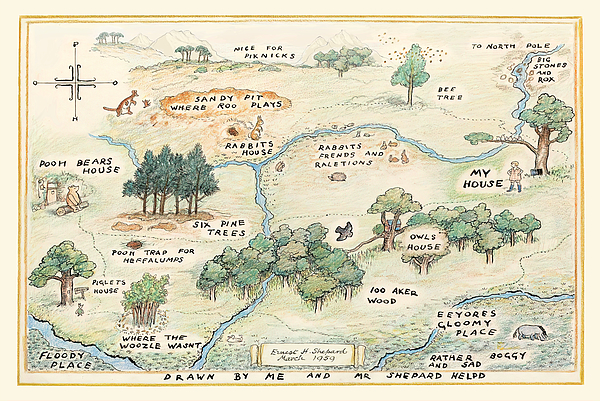
It might sound silly to connect all of this to Winnie the Pooh and the adventures in the Hundred Acre Wood, but it seems to me that Winnie the Pooh’s habits mirrored those of the three I’s of the Christian journey. He begins with inward thought and reflection, remembers the needs and value of his friends, and shares what he has with others in a way that resounds and echoes throughout the woods.
As we seek to become people who live and love like Jesus, we are called to intercession–to pray for ourselves and others, to remember that each person we encounter is made in God’s image, and to imitate God in all we do.
I recently came across a story written by Annie Dillard that reminded me about the joy that comes from imitating the love and grace of God. She writes:
When I was six or seven years old, growing up in Pittsburgh, I used to take a precious
penny of my own and hide it for someone else to find. It was a curious compulsion;
sadly, I’ve never been seized by it since. For some reason, I always “hid” the penny
along the same stretch of sidewalk up the street. I would cradle it at the roots of a
sycamore, say, or in a hole left by a chipped-off piece of sidewalk. Then I would take a
piece of chalk, and, starting at either end of the block, draw huge arrows leading up to
the penny from both directions.
After I learned to write I labeled the arrows: SURPRISE AHEAD or MONEY THIS WAY. I
was greatly excited, during all this arrow-drawing, at the thought of the first lucky
passer-by who would receive in this way, regardless of merit, a free gift from the
universe. But I never lurked about. I would go straight home and not give the matter
another thought, until, some months later, I would be gripped again by the impulse to
hide another penny.
As we intercede in prayer, as we remember that every person we encounter (including ourselves) is made in God’s image, and we are sent forth to be imitators of God, I wonder what random acts of kindness or joy we might feel urged to do. Maybe we won’t hide pennies and lead people to them with giant chalk arrows, but perhaps we will sprinkle joy, kindness, and hope around us in other ways. If you aren’t sure what God might be calling you to do as an imitator of God, begin with prayer…and maybe make it a walking prayer, or a winterize the yard prayer…or a quiet moment in the shower prayer. Allow God to show you the truth that you are beloved, made in God’s image, and so is every person you encounter. Then see what ideas might appear. And then, let them resound like a beautiful echo that points people back to the love and grace of God. Amen.