The Peregrinations of Our Stories – Exodus 20:1-20 and Philippians 3:4b-14
I love to read! As a pastor who is also a librarian, you might never guess that. April can tell you that in just about every free moment I have (which admittedly are not abundant), you will likely see me with a book in my hands: waiting in the doctor’s office, in the moments before bed, when my kids have taken control of the TV and are watching something I don’t want to watch, on my lunch break, sometimes when April is talking to me and I really should be listening instead. I love to read because stories remind me that my life is not the only life, there are still surprises, magic does exist, good will ultimately prevail. Stories can be an escape from the trials of life, but they can also be a mirror, revealing to me the truth of the life I live.
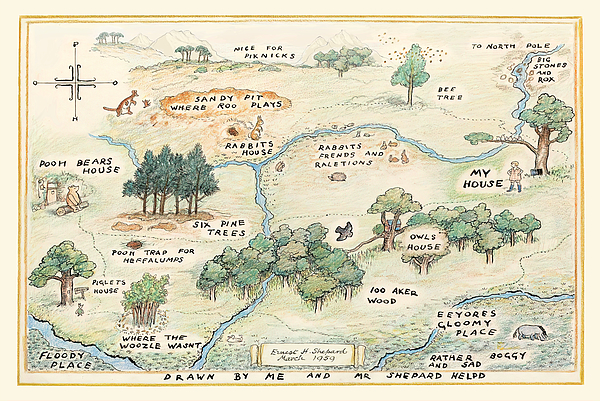
A.A. Milne began writing Winnie the Pooh stories for his son Christopher Robin Milne. Milne brought his son’s stuffed animals to life. Bruce G. Epperly, in The Gospel According to Winnie the Pooh writes, “A.A. Milne begins the story of a bear and his woodland friends with, ‘Here is Edward Bear, coming downstairs now, bump, bump, bump, on the back of his head, behind Christopher Robin.’ A world opens up in which stuffed animals reveal the deepest truths of life. The storyteller and the listeners discover themselves in the stories that are spun.” Milne takes a small part of his real life and transforms it into a story that reaches all of us, with beauty and wisdom. Stories have the power to speak into our hearts in ways that proverbs and lists of rules and passionate arguments cannot. Stories disarm us, help lower our defenses, so that the truth of the message can get through to our hearts.
In Exodus 20, God presents to God’s people through Moses a list of rules. The Ten Commandments stand as the base of the Jewish faith. They undergird all of the 600 plus Levitical laws. They stood at the center of every religious question asked of the rabbis and prophets and Pharisees. Perhaps you remember Luke telling of the expert in the law who came up to Jesus and asked him what he must do to inherit eternal life. Jesus responded to him, saying, “What is written in the law? What do you read there?” Jesus is, of course, referring to the Ten Commandments. The expert answers, “You shall love the Lord your God with all your heart and with all your soul and with all your strength and with all your mind, and your neighbor as yourself.” Jesus applauds that answer and tells the man to go forth and live in that way. But the expert isn’t quite done. He asks Jesus, “And who is my neighbor?” It is in responding to that question that Jesus tells one of the most well-known stories in the Bible, the story of the Good Samaritan. Perhaps we don’t remember all of the details of the story, but most everyone knows what a “good samaritan” is. Jesus knew that power of storytelling, and he used it often to communicate important truths.
The stories of Winnie the Pooh teach all sorts of important lessons through these engaging characters that readers find easy to fall in love with. Winnie the Pooh teaches lessons like the value of friendship, finding happiness in simple things, and practicing patience. One of Pooh’s famous quotes about patience is “Rivers know this: there is no hurry. We shall get there some day.” About simplicity, Pooh says, “Sometimes the smallest things take up the most room in your heart.” And Pooh talks about cultivating friendships, saying, “You can’t stay in your corner of the Forest waiting for others to come to you. You have to go to them sometimes.” These small grains of wisdom, when mixed into tales of stuffed animals come to life in the Hundred Acre Woods, speak to us in a deeper, more relatable way that the statements just by themselves. Jesus understood that. In fact, the entire Bible is the result of storytelling.
The first complete manuscript of the Bible did not come about until the 4th century under Emperor Constantine. It was handwritten on 730 pages of animal hide. Each of the original books of the Bible had been written down at various earlier dates, but prior to 70AD, the primary method of transmission was through spoken word. The Scriptures were passed from generation to generation through oral recitation and storytelling. In the gospel of Luke, we see Jesus going into the synagogue, as was his custom, and he unrolls the scroll of Isaiah. He reads a portion and then says, “Today this scripture has been fulfilled in your hearing.” This was a traditional Jewish way of sharing the message of the Scriptures. Someone would read a passage of Scripture and then tell a story from their lives that illustrates a truth from the passage. That is really the essence of what we preachers try to do as well.
In the passage we read from Philippians this morning, we see Paul using stories of his life to make a point to the church at Philippi. He writes to them, “If anyone else has reason to be confident in the flesh, I have more: circumcised on the eighth day, a member of the people of Israel, of the tribe of Benjamin, a Hebrew born of Hebrews; as to the law, a Pharisee; as to zeal, a persecutor of the church; as to righteousness under the law, blameless.” While Paul doesn’t give the whole story of these experiences, his references here would have brought stories to mind for his hearers. “Circumcised on the eighth day, a member of the people of Israel, of the tribe of Benjamin, a Hebrew born of Hebrews” – This was all a sign of Paul being Jewish from birth and born into one of the most prominent tribes, a purebred Hebrew. “As to the law, a Pharisee” – The Pharisees were the law experts. They were the judges and the lawyers. They knew the Scriptures better than anyone else. “As to zeal, a persecutor of the church” – Paul had been so committed to the truth of the Jewish faith that he persecuted Christians for blaspheming the name of God by claiming that Jesus was the Son of God and King of the Jews. That was a sign of his true devotion to the faith. “As to righteousness under the law, blameless” – Paul had abided by Jewish law as well as anyone. Paul tells these stories, not to brag, but to make a point. The point being that none of his personal achievements mean anything in comparison to the “value of knowing Christ.” All that truly matters, according to Paul, is faith in Christ. He refers to his own stories in order to point people to Jesus.
Today is World Communion Sunday, where we join with churches all across the world at the table of the Lord, where we hear again the story of Jesus. At the table, we participate in the reenactment of that story, accepting from Jesus the bread which is his body given for us on the cross, and the juice which is his blood shed for us for the forgiveness of our sins. This is the central story of our faith. And when we come to the table, we bring our own stories. And our stories become a part of this greater story of our faith. This greater story is the good news which empowers us to “press on toward the goal, toward the prize of the heavenly call of God in Christ Jesus.”
In “The Gospel According to Winnie the Pooh,” Bruce Epperly talks about spreading the gospel story “inscribed in the peregrinations of everyday life.” We share our stories to point to this greater story of Jesus. Later, Epperly writes, “We are God’s good news people in our time, sharing in the never-ending story of God’s incredible love and amazing grace. A child is laid in a manger. A bear wanders the woods. A young boy yearns for adventures. A wise teacher walks Galilean pathways, letting the winds of the Spirit guide his way, not knowing what adventures God’s gentle providence has in store or who yearns for his healing touch. This is the gospel enacted and shared.”
What are your good news stories? Where have you seen God’s grace and love at work in your life? I remember being told in youth group that the call of every Christian is to tell the good news to others, especially to those who have never heard it. That always made me nervous. I was by no means an expert in the Christian faith and felt very unqualified to share anything about it. Now, as an adult and as someone who has studied the story of Jesus for years, I still feel unqualified to share that story. But I’ve also come to believe that the stories we are called to tell are our own, stories of the peregrinations (the journeys) of our lives, stories of God’s grace and love in our lives. Those stories are far less scary to tell because they are our own experiences, and we tell them, not to convert unbelievers, but because they are meaningful to us. We all have those stories. They may be about ourselves, about others, or even about a little bear with an incredible heart. On this World Communion Sunday, let us embrace our stories, let us listen to the stories of others, and let us join those stories to the story of Jesus and the love and grace we’ve found in him. Amen!