God’s Expansive Grace – Jonah 3:10-4:11; Matthew 20:1-16
When I was a kid, my brother and I loved playing the game “Opposite Day.” Have you ever done this? When we played the “Opposite Day” game, we would try to say the opposite of what we meant all day long. If someone asked, “What’s your favorite food?” We’d answer, “Vegetables,” and then start laughing. I’d ask my brother, “Do you want to go ride bikes?” and he’d say, “No. I hate riding my bike,” and then we’d both laugh and go outside to ride our bikes around the neighborhood. “Opposite Day” was a fun game because not everyone was in on the joke. We’d do or say things that were unexpected or ridiculous, and then laugh to ourselves because we knew we were being silly and the other person didn’t. Eventually, we’d crack and tell them, “It’s Opposite Day!” And then they would join us in laughing at the joke.
For people who were familiar with the stories of the prophets, the book of Jonah might have felt a little bit like “Opposite Day.” When God called the well-known prophets to get up and go somewhere, the prophets got up and went immediately without so much as a hesitation. When God calls Jonah to get up and go, Jonah gets up and runs the opposite direction. God called Israel’s prophets to go to the people of Israel or to Israel’s leaders and preach a tough message of repentance. God calls Jonah not to go to his own people or his own leaders, but to go to Ninveh–the capital city of their most hated enemy, the Assyrians. When Israel’s prophets preached a message of repentance, no one wanted to listen to them. They were mocked, or persecuted, or thrown out of the city. When Jonah preached a half-hearted message of repentance to Nineveh, every single person repented in an instant. Even the king–who had prided himself on his cruelty and power–put on sackcloth and ashes to repent and grieve his sins before the Lord.
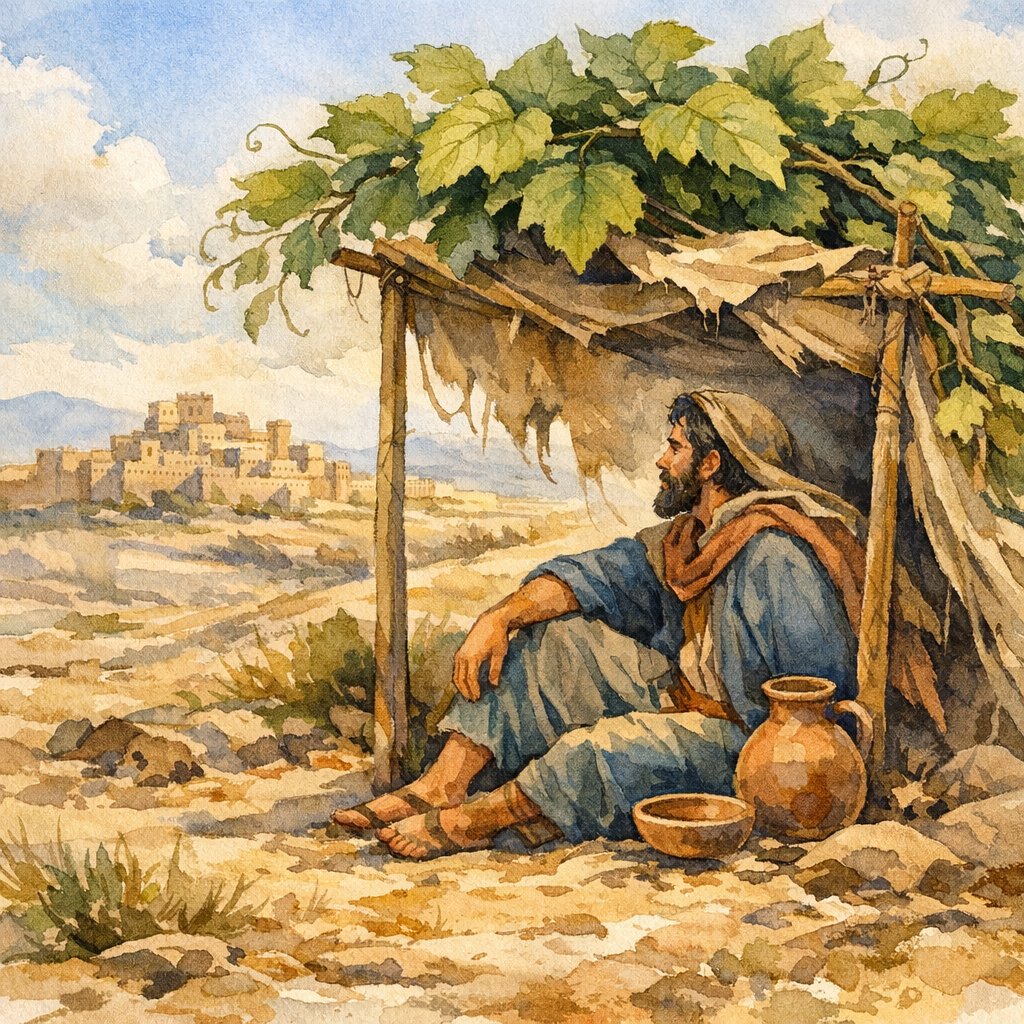
So, you would think that Jonah, the prophet who never wanted to go to Nineveh in the first place, would be delighted that his preaching was effective, right? You’d think he would sit back and think, “I was afraid to come here and do what God asked, but look how awesome it all turned out!” Instead, Jonah is furious. He is furious because he hated the Assyrians. He hated the people of Nineveh, and he didn’t want them to receive the love of God. He wanted them to be destroyed. Jonah 4 describes the prophet’s reaction this way:
“But this was very displeasing to Jonah, and he became angry. He prayed to the Lord and said, ‘O Lord! Is not this what I said while I was still in my own country? That is why I fled to Tarshish at the beginning, for I knew that you are a gracious and merciful God, slow to anger, abounding in steadfast love, and relenting from punishment. And now, O Lord, please take my life from me, for it is better for me to die than to live.’”
From our comfy pews we might think Jonah is terrible for thinking this way, but if we pause to remember how the Assyrian Empire behaved during their reign of terror, we might find ourselves agreeing with Jonah.
Assyria grew into an empire not just because of their military conquests but also because of their extreme cruelty. They were known not just for conquering other cities and nations, but for the way they psychologically tortured their enemies. They were incredibly proud of their cruelty, and they carved pictures of torture and destruction into cave walls and stones to intimidate anyone who might have considered standing up to them. King Ashurnasirpal II of Assyria had graphic depictions of torture and conquest carved into the stones of his palace walls so that visiting foreign leaders would see and be afraid. The Assyrian Empire took pride in displaying their savagery as graphically as possible, with historian Arthur Ferrill comparing these images to photos of Nazi concentration camps.
The Bible even records a story of the Assyrian army engaging in psychological warfare against the people of Israel. In 2 Kings 18, the King of Assyria sent his supreme commander to the people of Israel to try to intimidate them to surrender. Assyria’s supreme commander didn’t speak to the people in Aramaic, so that only the higher ups could understand him. He spoke in Hebrew so that the common person sitting on the wall could hear what would happen to them if they didn’t surrender. The supreme commander threatened to isolate the people of the city until they starved to the point of having to survive on their own waste. This is how the Assyrians operated, and this is who God called Jonah to go and preach to. Jonah didn’t want these people saved; he wanted them to have a taste of their own cruelty.
But that’s not who God is, and Jonah knew it. Jonah knew that God was a God of grace, love, and forgiveness. Why on earth would Jonah want to tell the Assyrians he hated so much that God could forgive them and love them? I can’t blame him for being unhappy about the job God had given him. I can even see why he needed three days in the belly of a big fish to change his mind. The people of Nineveh were people he didn’t want to forgive, and he certainly didn’t want God to forgive them either.
When we look at this story next to the parable of the laborers who all received the same amount of pay regardless of how much or little they worked, I can’t help but think this: “It’s never too late.” The people of Nineveh weren’t too far gone to be saved by the expansive grace of God. The laborers who showed up for the last hour of work weren’t too late to matter in God’s kingdom. Sometimes, we can convince ourselves that we’ve sinned so much, or gone too far down the wrong path to be redeemed. We might think, “I’ve already gone so far off from God wanted for me that I have no other choice but to keep going the wrong way,” but the passages from Jonah and Matthew say something different. It’s never too late for anyone when it comes to God’s grace.
As many of you know, my family has been going through a season where a lot seems to be going wrong. We’ve had problem after problem with things in our house and in our yard, and then our main car died and is beyond repair. Then yesterday, as we were attempting to go on a short trip out of town, we ended up stranded on the side of the road with smoke billowing up from under the hood. As we stood there together, part of me was tempted to ask “Why me? Why us?” but then, we asked for help, and help was there… not just in people to bring us home, but people to help us push our car onto a trailer, people who showed love and hospitality and infused our day with delight. No matter how far off from “right” things might seem to be, God’s grace and love are always right there calling and shining.
Jonah’s story urges us to remember that no one is too far gone for God’s redeeming–even us. Jesus’s parable in Matthew reminds us that even those who come late will be welcomed as though they had been there the whole time. As we consider what these passages mean for us, I wonder if we might think about this together: 1) What is one area of our lives that we have thought was too broken for God’s redeeming? Both of these passages also urge us to think outside of ourselves and to think about who in our lives we have excluded or ostracized from God’s transforming love, but today I want us to look at ourselves with a close-up lens and choose to view ourselves with the same compassion God does.
What is one area of our lives that we have thought was too broken for God’s redeeming? For Jonah, he didn’t even realize his anger toward the Assyrian Empire (though totally justified) was something in need of redeeming. When God asked Jonah, “Is it right for you to be angry about the bush?” Jonah said, “Yes, angry enough to die.” Jonah knew all the facts. If he were to make a pros and cons list about the Assyrian Empire, he knew there would be able evidence to condemn the people and write them off as no-good evildoers. But deep down somewhere, he knew that even they were not beyond God’s redeeming. That’s why he hadn’t wanted to go to Nineveh in the first place. If he went and told them about God’s mercy, they might actually change. And that wasn’t a risk he was willing to take.
So, he remained angry and judgmental. He remained possessive of God’s grace, unwilling to share. The end of the book of Jonah never tells us how Jonah reacted to God’s mercy toward Nineveh. As far as we know, he’s still sitting on that hillside angry that God didn’t call down fire and brimstone on them. Yet, the book ends with a question from God: “And should I not be concerned about Nineveh, that great city, in which there are more than a hundred and twenty thousand persons who do not know their right hand from their left and also many animals?” The book ends with God’s compassion toward Nineveh and God’s desire that the people be transformed. The book also ends with a question, in part I hope because maybe Jonah isn’t too far gone to be redeemed either. Maybe, just maybe, if Jonah allowed his anger to be redeemed a little bit, he would begin to see the people as God did–people who didn’t realize how far off the mark they were, people who were in need of transformation just like the rest of us.
What is one part of your life that you have thought was too far gone for God to redeem? Maybe you deal with anger or judgment like Jonah did. Or, maybe you’re dealing with an addiction, or with a deeply ingrained pattern of behavior that feels impossible to change. Or, maybe you struggle to see yourself as a person worthy of love, and God is whispering to you that you don’t have to live in shame and self-judgment forever. Take a moment to reflect on that one part of yourself, and then hear God speak over you, “Should I not be concerned about my child who is suffering so, this person I loved so much I gave my all for them?” Friends, no part of you is too far gone to be redeemed. No part of you is too broken to be healed.
I don’t know about you, but I tend to view those broken parts of my life a lot like Jonah viewed the people of Nineveh. He knew they deserved to be punished, and he was ready for God to do the punishing. I can look at those broken parts of myself, like my lack of faith when times are tough, or my own insecurity in who God created me to be, and I can point and scoff just like Jonah. But, what if I viewed them as God viewed the people of Nineveh? What if I looked at the times I worried instead of trusting in God, and heard God say, “Should I not be concerned about my child who is suffering?”
Let’s take a moment this week to explore those areas of our lives that have gone off track. Let’s confess our sins to God and ask God to restore and redeem us. But then, let’s also look at those broken places with compassion instead of further shame and judgment. After all, God created us. God loves us. And God wants us to be made whole. May we experience the forgiveness and grace of God who loves lavishly. May we be unafraid to bring even our broken pieces to God, trusting that the God who made us will want nothing more than to make us whole again. Amen.